Home Work
SaaS developmentAI developmentAPI developmentMobile app developmentGoogle Ads managementHeadless ShopifyLaravel developmentNext.js developmentReact developmentTypeScript engineeringUI/UX designSEO & AEOEcommerce development
AI solutionsB2B platformsE-commerceHospitalityLead generationLogisticsEducationProcess automationSaaS platformsStartup MVPReal estateHealthcare
LegalHealthcareReal estateFinanceHospitality
The HagueRotterdamAmsterdamUtrechtEindhovenAlmereBredaArnhemNijmegenTilburgEnschedeGroningenLeidenDelftZoetermeerDen Bosch
Studio
AboutProcessLabBlogContact
STUDIO Nº 04 · NEDDEV ATELIER AI · VISION · USA · 2026
CASE · 03 OF 32

JinSulate

Blueprint to insulation report in seconds. Computer vision · Shapely · FastAPI.

JinSulate AI blueprint analysis for the US market
In short

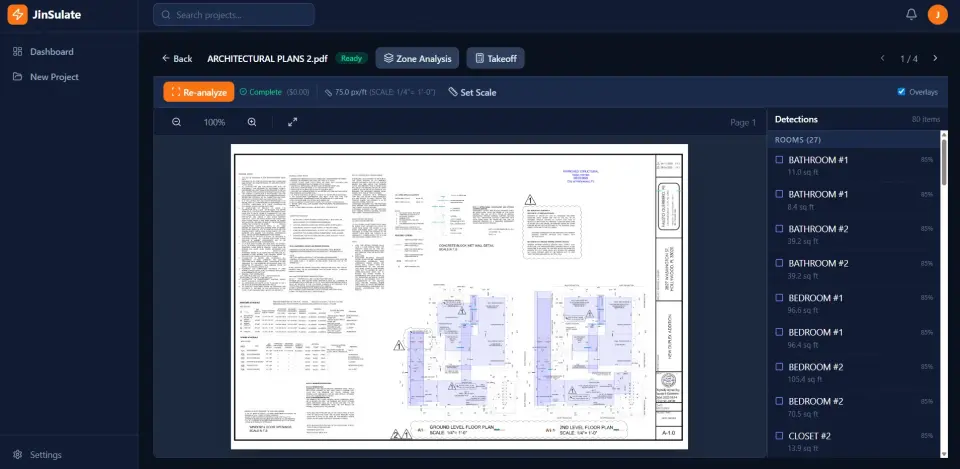
JinSulate turns a blueprint into an insulation report in seconds. Computer vision and Shapely read the PDF deterministically and compute the net insulation area per wall. The vector detection is 100% reproducible and 23 tests guard the pipeline. Built for the US market on FastAPI and Next.js.

Next.jsReact 19TypeScriptLaravel 12Tailwind CSSFilamentNode.jsPythonPostgreSQLRedisSupabasePrismaShopifyStripeMollieGraphQLtRPCReact NativeOpenAIAnthropic ClaudeLangChainRAGComputer VisionPineconeAWSCloudflareVercelDockerKubernetesTerraformThree.jsWebGLGSAPFramer MotionPlaywrightVitestNext.jsReact 19TypeScriptLaravel 12Tailwind CSSFilamentNode.jsPythonPostgreSQLRedisSupabasePrismaShopifyStripeMollieGraphQLtRPCReact NativeOpenAIAnthropic ClaudeLangChainRAGComputer VisionPineconeAWSCloudflareVercelDockerKubernetesTerraformThree.jsWebGLGSAPFramer MotionPlaywrightVitest
OWN IP · STUDIO OUTPUT

Not just client work. Our own products too.

— CHALLENGE

The challenge at JinSulate.

Insulation contractors in the United States get their material quantity from a slow manual takeoff: measuring wall area on each blueprint, subtracting windows and doors, and arriving at the net insulation area. That handwork is error-prone and costs hours per bid.

NedDev was asked to build a tool that reads a PDF blueprint and pulls out the orderable square footage of insulation. The hard part was reliability. A report that returns different numbers on each run is useless for a quote. Reproducibility was a firm requirement, not a nice-to-have.

— APPROACH

Our approach.

We chose a geometry-first hybrid. Using PyMuPDF and Shapely we deterministically extract the wall perimeter and candidate openings from the drawing's vector layers. Computer vision does the measuring, not the guessing.

A Claude model reads only the schedules: window and door types, dimensions, scale and building measurements, all stable across runs. A separate geometric counter matches each detected opening to the correct schedule entry by size, with no double counting. The backend runs on FastAPI with Celery workers, and the takeoff calculation itself is pure Python arithmetic. The Next.js frontend lets the contractor upload the drawing and read back the report.

— OUTCOME

What it delivered.

The result is a working beta that turns an uploaded blueprint into an insulation report in seconds, with net square footage as the final figure. Because the count rests on the vector geometry, the same drawing yields the same numbers on every run: reproducible, not at the mercy of an AI call.

The determinism approach is backed by a test suite that passes at both unit and pipeline level. That leaves a foundation ready for validation against a broader set of drawings, on the path to production in the American market.

YOUR NEXT PROJECT

Ready for your next build.

Book an intro → Direct line to the founder · M. Tufan